
Adhesives & Application
How to Choose a Construction Adhesive for Wood, Metal and Concrete
Choose construction adhesives for wood, metal and concrete by substrate, load, cure conditions and preparation. Use a practical buyer approval checklist.

AI-generated illustration: material samples used to discuss a construction bonding application.
General buyer education, not a product specification. Confirm the current technical data sheet and project requirements before purchase or application.
In this guide
Introduction
Choose a construction adhesive by the complete bonding situation: the two surfaces, their condition, the load, exposure, joint geometry and curing conditions. A product's initial grab, cartridge description or advertised strength cannot establish whether it will work in your assembly. Obtain product-specific instructions and validate a representative sample before approving a substantial order.
For distributors and private-label buyers, this approach also improves range planning. Instead of looking for a single “strongest glue,” identify the installation problems customers actually need to solve. Fixing an interior timber trim to plaster is different from bonding coated metal to dense concrete. A decorative application is different again from a connection whose failure could injure someone.
This guide focuses on general construction bonding and practical procurement. It does not design structural connections, approve façade attachments or replace an engineer's specification. Any reference to testing describes a proposed evaluation process, not an assertion that HANHU has completed a particular test or achieved a stated certification.
1. Define the application before choosing the chemistry
Start with a sentence that describes the assembly. “We need an adhesive for metal” is not enough. “We need to fix painted aluminium trim to an interior concrete wall, with temporary support available during curing” is a much better starting point.
List what each surface actually presents to the adhesive. The bond may contact a powder coating, paint film, primer, laminate or sealer rather than the underlying metal, wood or concrete. Identify whether either surface is porous and whether its finish could be damaged by the adhesive or required cleaner.
Then describe the service conditions: interior or exterior, intermittent moisture or immersion, expected temperature exposure, vibration, cleaning chemicals and any movement between materials. Avoid summarising all of this as “waterproof” or “heavy duty.”
Finally, state the consequence of failure. An installer can assess a decorative sample differently from an overhead panel. High-consequence applications need product-specific approval and appropriate engineering, not a more persuasive catalogue adjective.
2. Initial grab, handling strength and final strength are different
Initial grab concerns how the adhesive helps hold an assembly immediately after positioning. Handling strength concerns when the assembly can be moved or lightly worked under specified conditions. Final strength refers to a later, defined state of cure and test conditions.
A high-grab product may still require temporary support. A surface that feels dry does not prove the centre of a thick bond line has cured. An early successful pull by hand does not establish resistance to long-term loading or environmental exposure.
Ask suppliers to define each time claim. At what temperature and humidity was it determined? With which substrates, bond-line dimensions and test method? Does the published time mean skin formation, handling, or readiness for the intended service?
For procurement, record the production or installation timetable alongside the product selection. If the installer must remove supports after a fixed period, that is a requirement to validate, not an assumption to make from the phrase “fast cure.”
3. Why joint design matters as much as the adhesive
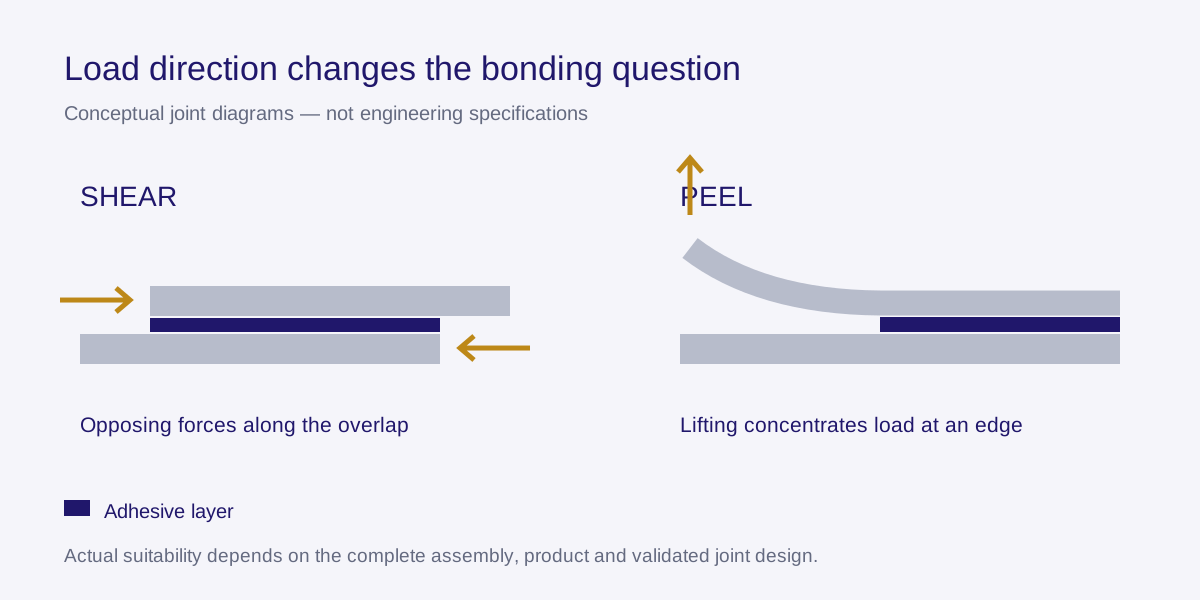
Shear, peel and cleavage
Loads distributed across a bonded area are different from forces concentrated at an edge. A joint may carry a modest average load yet start failing where a flexible strip peels away or where a rigid part acts as a lever.
3M's adhesive-joint guidance explains the importance of joint configuration and reducing unfavourable peel or cleavage loading. This is a useful design principle, not permission to turn a published laboratory strength into an allowable building load. Source: 3M, designing adhesive joints for strength.
Bond area is not a complete load calculation
Multiplying a catalogue strength by the apparent bond area leaves out test geometry, ageing, workmanship, substrate failure, load duration and safety requirements. Do not use that shortcut to approve a panel, fixture or safety-critical connection.
Share a sketch or photographs with the supplier. Include dimensions, support points, edge conditions and how the component will be loaded. If an engineer's review is required, involve that person before ordering rather than after the adhesive has arrived.
4. Compare adhesive families as screening options
Chemistry helps narrow a shortlist, but it does not replace an individual technical data sheet. Products within the same family can have different intended uses and restrictions.
| Screening category | Questions to ask before selection |
|---|---|
| Water-based construction adhesive | Does the assembly allow the required drying? Is the product suitable for the proposed moisture exposure and substrates? |
| Solvent-based construction adhesive | Can solvent escape as required? Are the materials compatible, and what handling controls does the SDS require? |
| One-component moisture-curing adhesive | Can the specified assembly cure at the expected temperature, humidity and bond-line dimensions? |
| Two-component adhesive | Can the installer control the mix ratio, mixing quality, working time and approved joint geometry? |
For example, Bostik's Australian No More Nails guidance states that at least one substrate should be permeable for solvent release. That is a product-specific limitation illustrating why “bonds many materials” does not mean every possible pairing is approved. It is not a rule to copy automatically onto all construction adhesives. Source: Bostik No More Nails.
Request a shortlist based on the application brief, and ask why each proposed product is suitable. A clear explanation of restrictions is more valuable than a long, unqualified substrate list.
5. Bonding wood: inspect the surface, not just the species
Wood can arrive unfinished, painted, treated, laminated, dusty or carrying a manufacturing surface layer. Manufactured boards also differ from solid timber. Ask the installer to identify the actual bonding face and obtain approval for any coating or treatment present.
Include the expected moisture condition and movement in the discussion. A sample taken from a dry indoor workshop may not represent material stored outdoors before installation. If the project has a specified moisture limit, record how it will be assessed rather than substituting a generic internet value.
Installation preparation should follow the selected adhesive's instructions. Agree on cleaning, any permitted abrasion, and when the prepared surface must be bonded. Do not assume that stronger clamping or a thicker bead corrects a poor surface.
For a distributor, obtain representative samples from the customer rather than relying exclusively on standard demonstration blocks. The trial should include the finish, backing and assembly arrangement that will appear in the real order.
6. Bonding metal: qualify coatings and contamination
“Metal” can mean bare steel, galvanised steel, aluminium, stainless steel or a painted surface. These are not interchangeable adhesive substrates. An apparently clean component may also carry handling oil, release material or other contamination.
Ask the supplier for a preparation process for the exact surface. Do not prescribe one solvent, primer or abrasive treatment for every metal. Check that any cleaner is compatible with both the substrate finish and the adhesive process, and follow the relevant safety instructions.
Where the assembly is bonded to paint or powder coating, assess whether that layer is securely attached and compatible. A strong bond to a weak coating does not make a strong assembly. Record whether test failure occurred at the adhesive interface, within the adhesive, in the coating, or in another part of the assembly.
If the finish changes between sample approval and production, treat it as a change requiring review. A visually similar coating is not automatically the same bonding surface.
7. Bonding concrete: confirm a sound, suitable surface
A concrete wall may carry dust, laitance, curing compounds, old paint, a sealer or repair material. The adhesive interacts with that surface, not an abstract label saying “concrete.” A weak surface layer can become the limiting part of the assembly.
Ask what preparation and moisture condition the chosen product requires. If a substrate assessment or primer is specified, include it in the work instructions and cost comparison. Do not treat primer as an optional upgrade or assume every adhesive needs the same one.
A dense sealed surface may behave differently from an absorbent unsealed surface. This matters when the proposed adhesive depends on drying or has product-specific porosity restrictions. Check the complete pairing rather than only one side.
For practical sampling, use a representative piece or trial area from the intended substrate. Keep records of any sealer, repair compound or previous coating. Otherwise, a passing laboratory specimen may answer a different question from the one the installation presents.
Technical support
Which adhesive fits your two substrates?
Share the materials, surface finishes, exposure and support time. Ask for product-specific guidance before approving a sample.
8. Treat curing conditions as part of the specification
Temperature, humidity, bond-line dimensions and the ability of the assembly to support the required curing process can affect product application. Follow the individual technical data sheet rather than setting one cure schedule for the entire adhesive category.
Sika's guidance for one-component Sikaflex products discusses the relationship between product application and conditions such as temperature and humidity. Its instructions are for the named systems and should not be transferred to unrelated products. Source: Sika bonding and sealing guideline.
Create a simple installation record: date, product batch, surface preparation, approximate conditions, bead arrangement, assembly time and support-removal time. If conditions differ substantially from the approved trial, pause and obtain advice.
Do not accelerate curing with uncontrolled heat, improvised additives or changes to the mix ratio. For two-component products, a second component is not a general-purpose accelerator. Process shortcuts should never be invented to recover a delayed installation schedule.
9. Turn customer requirements into an approval test
Agree the question being tested
Before starting, write down what the sample must demonstrate. Examples include application through the intended gun, positioning within the required working time, acceptable appearance, and performance under a defined evaluation agreed with the supplier or engineer.
Reproduce the assembly
Use the actual substrate finish and the proposed preparation method. Record bead dimensions, spacing or coverage according to the selected product's instructions. Use the intended support arrangement and allow the specified curing period.
Record the result and failure location
A trial report should say how the sample was evaluated and what happened. Photographs of a bonded piece alone are not a strength test. Where a recognised laboratory method is required, identify the method, specimen, conditions and acceptance criteria. Do not describe an informal workshop pull as certified testing.
Match the evidence to the claim
An interior dry-condition sample does not prove exterior durability. A short trial does not establish a service-life guarantee. Ask what additional evaluation is needed for the intended exposure and consequence of failure. This keeps useful factory testing separate from claims it cannot support.
10. Estimate consumption from the approved bead pattern
Cartridge count should follow the validated application pattern, not an arbitrary number of “dots” per panel. Ask whether the product requires beads, spots or another arrangement for the assembly.
For a purely geometric example, a circular bead 6 mm in diameter has a cross-sectional area of approximately 28.3 mm². One metre of that bead occupies about 28.3 mL. A nominal 300 mL cartridge would therefore provide approximately 10.6 metres before application losses and residual material.
This calculation does not specify a suitable bead size or a safe bond. A triangular bead, compressed bead or different nozzle produces a different geometry. Actual usable quantity should be checked during the trial.
Round procurement to complete packs and account separately for nozzle changes, partially used cartridges and installation waste. When comparing prices, calculate cost per approved assembly, including any required primer and temporary support, rather than comparing cartridge prices alone.
11. Control the move from approved sample to shipment
Once the application is approved, preserve the information that made approval meaningful. Record the product code, version, colour, pack, preparation products and relevant documents. Keep an approved sample reference and its evaluation record.
Before shipment, reconcile the order against those details. Shipment inspection can check the specified packaging, batch identification, quantity and agreed condition criteria. It should not be presented as proof of every long-term bonding claim.
Ask how formula or packaging changes will be communicated. A different cleaner, primer or surface finish at the installation stage may also justify a fresh compatibility check. Change control must cover the assembly, not just the adhesive brand name.
For a distributor range, prepare a short application guide with clear exclusions. Train sales staff to ask about the two surfaces and exposure rather than recommending the same adhesive whenever a customer asks for “the strongest one.”
12. What to include in a supplier enquiry
Provide the destination market, intended application, both materials, surface finishes, load description, exposure, expected installation conditions and estimated order volume. Add photographs or a drawing when the assembly is difficult to explain.
Ask for the relevant TDS and SDS, a recommended evaluation process, packaging options and the restrictions that customers must understand. If a standard or approval is required, identify it precisely and request evidence for the exact product, not a general factory certificate.
Explore the HANHU product range as a starting point. If the task is primarily sealing a moving joint rather than attaching components, consult the separate sealant comparison guide. Bonding and sealing can overlap, but the performance questions are not identical.
Frequently asked questions
What is the strongest construction adhesive?
There is no useful universal answer. The appropriate product must work with the actual surfaces, joint design, load and exposure. Compare products under a relevant, agreed evaluation rather than ranking unrelated laboratory figures.
Can construction adhesive bond metal to concrete?
Some products may be suitable, but the exact metal finish, concrete condition, moisture, geometry and load must be assessed. Obtain a product-specific recommendation and validate the assembly. Do not assume a general substrate list establishes suitability for a safety-critical connection.
Does high grab mean I can remove supports immediately?
No. Initial grab and readiness for service are different. Follow the support and curing requirements for the selected product and assembly. Where support-removal time is commercially important, include it in the approval trial.
Can I bond two non-porous materials?
It depends on the adhesive and assembly. Some products have permeability restrictions, while others use a different curing process. Confirm suitability for both surfaces together, including the bond-line geometry, rather than checking each material separately.
Is a sealant a substitute for a construction adhesive?
Not automatically. A product intended to seal a joint may not meet the bonding requirement. Some products have both uses, but the relevant application must be supported by their instructions and evidence. Names and packaging formats do not establish interchangeability.
Why did the adhesive remain soft inside the joint?
Possible causes depend on the product and can include an unsuitable assembly, curing conditions, bond-line dimensions or product condition. Preserve the sample and batch details and ask the supplier to investigate. Surface appearance alone cannot identify the cause reliably.
Conclusion
Construction adhesive selection is an assembly decision. Define the surfaces and service conditions, distinguish initial grab from final performance, agree preparation and curing, and evaluate a representative sample before scaling up.
The purchasing objective is not simply to obtain a powerful adhesive. It is to obtain a repeatable bonding process that installers can follow and that the available evidence actually supports.