
Coatings & Procurement
How to Calculate Paint Coverage and Cost per Square Metre Before You Order
Calculate paint quantity, compare theoretical and practical coverage, and estimate cost per square metre before ordering coatings for your project.

AI-generated illustration: planning coating quantities with sample panels and a project area schedule.
General buyer education, not a product specification. Confirm the current technical data sheet and project requirements before purchase or application.
In this guide
Introduction
To estimate paint quantity, divide the paintable area by the stated coverage per coat, multiply by the required number of coats, and then apply a clearly defined allowance for the actual job. For a coating specified by dry film thickness, calculate the theoretical spreading rate from volume solids and the specified thickness first. Primer, finish coats, touch-up material and application losses should be considered separately.
For an importer, distributor or project buyer, this is more than a decorating calculation. An incorrect estimate can leave an installer short of material, create a colour-matching problem between deliveries, or make an apparently competitive quotation more expensive after application. Buying too much creates a different problem: money and warehouse space are tied up in stock that may not sell before its shelf life ends.
This guide explains how to build a defensible quantity estimate, compare suppliers on an equivalent basis, and turn an initial calculation into a useful purchasing specification. All numerical examples below are hypothetical teaching examples, not HANHU product specifications or quotations. Always use the current technical data sheet for the exact product, colour and system being considered.
1. What does paint coverage actually mean?
Theoretical coverage
Theoretical coverage describes how far a known volume of coating could spread at a specified film thickness under idealised conditions. It is a calculation, not a promise that every purchased litre will become useful coating on a project.
Hempel expresses theoretical spreading rate in square metres per litre using volume solids and dry film thickness. That relationship is particularly useful when comparing coating specifications rather than simply comparing pack prices. Source: Hempel spreading-rate calculator.
Practical coverage
Practical coverage is the area actually completed per litre under defined working conditions. A meaningful record identifies the substrate, its condition, the application method, the number of coats and the accepted finish. A coverage figure without these details is difficult to use commercially.
Hiding power
Hiding power describes how effectively a coating obscures the surface or colour underneath. It is not interchangeable with spreading rate. A film can reach its specified thickness and still require an additional coat for an agreed appearance. Conversely, a surface can look covered before the specified protective film has been achieved. Confirm both appearance and film-build requirements.
2. Start with a reliable area schedule
Before opening a calculator, define what will actually be painted. Divide the project into surfaces requiring different preparation, primers, products or colours. New plaster, previously painted walls, timber and metalwork should not automatically share one consumption assumption.
For a simple wall, calculate width multiplied by height. Decide whether openings will be deducted, and apply that convention consistently. Small reveals, returns, edges and narrow sections may take time and material even when they represent little area. Record these separately when they materially affect the job.
For railings or fabricated metalwork, the front-view outline is not the paintable surface area. Back faces, edges, profiles and accessible internal surfaces matter. Use drawings or a measured schedule and agree what is excluded.
Record the measurement basis with the quotation. A buyer should be able to answer: does this area include both sides, exposed edges, primer, and repair work? That short clarification can prevent a much larger dispute when consumption is reviewed later.
3. Calculate litres from a stated coverage rate
When the technical data sheet gives a usable coverage rate per coat, the starting calculation is:
Base quantity in litres = area in m² × number of coats ÷ coverage in m²/L per coat.
Consider an illustrative wall-paint order:
| Input | Hypothetical value |
|---|---|
| Paintable area | 600 m² |
| Finish coats | 2 |
| Stated coverage per coat | 10 m²/L |
| Base quantity | 120 L |
The calculation is 600 × 2 ÷ 10 = 120 litres. It excludes primer and any practical adjustment. If the approved pack contains 15 litres, eight packs provide the base quantity only.
Before using this calculation, ask whether the quoted coverage is theoretical or practical and whether it already refers to a complete two-coat system. Multiplying a whole-system coverage figure by two would count the coats twice.
For a stated range, do not automatically choose the most optimistic endpoint. Ask why the range exists and which conditions resemble the proposed project. If the answer is uncertain, use a representative application trial to narrow the estimate rather than disguising uncertainty with a precise-looking number.
4. Calculate coverage from volume solids and dry film thickness
For conventional film-build calculations:
Theoretical spreading rate, m²/L = 10 × volume solids (%) ÷ dry film thickness (µm).
For example, an illustrative coating with 50% volume solids applied at 50 µm dry film thickness has a theoretical spreading rate of 10 m²/L. At 100 µm, the calculated rate becomes 5 m²/L. These are arithmetic examples, not recommended thicknesses for a particular coating.
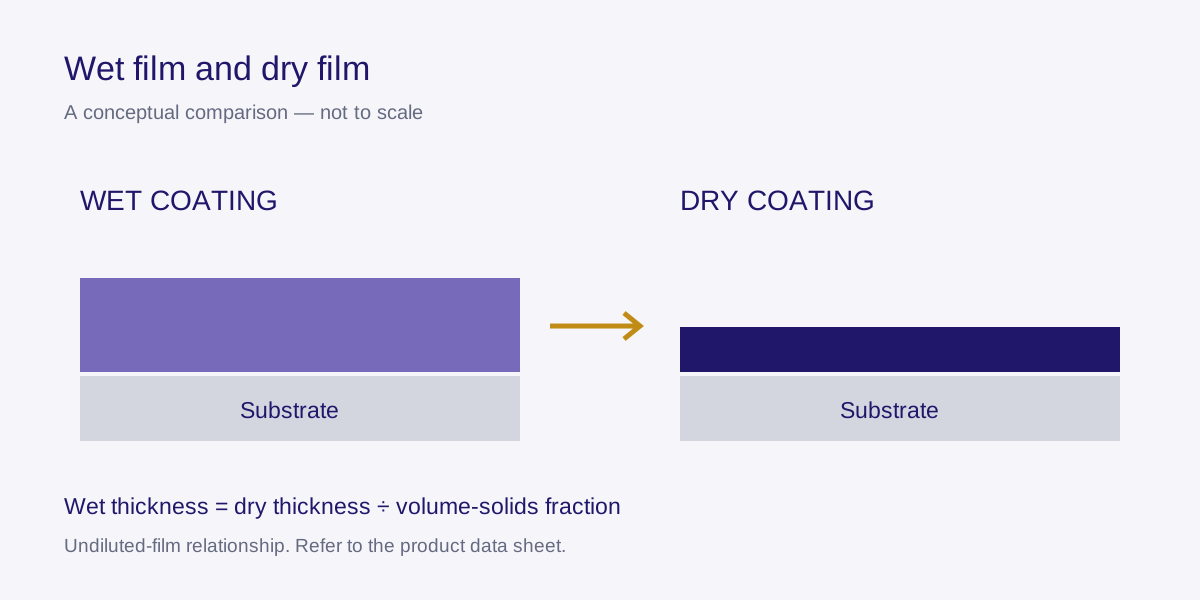
The related undiluted-film relationship is:
Wet film thickness = dry film thickness ÷ volume-solids fraction.
Thus, 50 µm dry film at a volume-solids fraction of 0.50 corresponds to approximately 100 µm wet film under the calculation's assumptions. Jotun's technical calculator presents the relationship between wet film thickness, volume solids and dry film thickness. Source: Jotun technical calculator.
Do not substitute weight solids for volume solids. Do not infer a dry film thickness from the coating's colour or gloss. If the data sheet does not provide the necessary information, request clarification instead of reverse-engineering a value from a competitor's product.
For textured coatings, fillers and other products sold with a consumption rate in kg/m², use the manufacturer's stated method. A smooth-film formula is not a universal calculator for every decorative material.
5. Define allowances without double-counting them
A common purchasing error is to use the word “wastage” for two different calculations.
An allowance added to the base quantity
If a project planner adds an illustrative 20% procurement allowance to the 120-litre base quantity, the result is:
120 × 1.20 = 144 litres.
A loss expressed as a fraction of purchased material
If the assumption is instead that 20% of purchased material will not form the required useful coating, the calculation is:
120 ÷ 0.80 = 150 litres.
These are different definitions, not interchangeable methods. Neither 20% figure is an industry recommendation. The suitable assumption depends on the job and should be supported by experience from comparable work or a trial.
Also establish whether the supplier's practical coverage figure already incorporates normal application losses. Adding another full loss factor can overstate demand. Keep repair stock and colour-specific touch-up quantities visible as separate purchasing decisions.
Hempel's explanatory notes similarly distinguish theoretical spreading rate from practical consumption and describe the use of a consumption factor dependent on external conditions. Source: Hempel explanatory notes.
6. Account for the substrate and application method
An estimate should state whether the surface is smooth, rough, porous, repaired or previously coated. The same nominal area can present very different working conditions. Ask the applicator to identify surfaces that need a separate primer, sealer, levelling material or repair system.
Application method also changes the planning discussion. A brush-and-roller job has different handling and access considerations from spraying complex metalwork. Rather than assigning an unsupported universal efficiency percentage, record the method, equipment, operator conditions and geometry used in the trial.
Do not solve an apparent coverage shortfall by thinning beyond the product's instructions. Additional liquid is not additional coating solids. It may change application behaviour without creating the specified final film.
For export orders, obtain the application instructions in a form the destination contractor can use. A purchasing team may understand the specification while the installer receives only a photograph of the pail. Include the approved preparation and application documents in the handover, not just the commercial invoice.
7. Compare cost per completed square metre
Price per pail is useful for cash-flow planning, but it does not show the cost of an accepted coating system.
For a simple comparison:
Finish-coat material cost per m² = price per litre × number of coats ÷ practical coverage per coat.
Suppose Product A costs US$4.00/L and, in an agreed comparable trial, covers 8 m²/L per coat. Two coats cost US$1.00/m² in finish-coat material. Product B costs US$4.80/L and covers 10 m²/L per coat in the same comparison. Its two-coat material cost is US$0.96/m².
This does not prove that Product B is better. The example excludes preparation, primer, labour, transport, equipment, waste handling and future maintenance. It also assumes equivalent accepted appearance and suitability. Its purpose is to show why the cheaper litre is not necessarily the cheaper completed area.
For a fair request for quotation, ask each supplier to price the same substrate, finish, area, system and pack basis. Compare technical suitability first, then the total relevant cost.
Technical support
Need a quantity estimate for your coating project?
Share the substrate, area, finish and application method. Start your enquiry with a clear basis for product selection and quantity planning.
8. Convert pack weight into volume carefully
A 20 kg pail is not automatically a 20-litre pail. If purchasing is by weight and the calculation is by volume, obtain the product's density for the relevant version and conditions.
Volume in litres = net mass in kilograms ÷ density in kg/L.
For a hypothetical density of 1.25 kg/L, 20 kg corresponds to 16 litres. This example is not a HANHU density value. Packaging tare weight must not be included as usable coating.
For a two-component system, confirm whether the quoted pack is the complete kit or only the base component. Check the mixing basis and the usable mixed quantity. Do not independently round base and hardener quantities in ways that change the specified ratio.
Once the required quantity is calculated, round up to available complete packs. Document the difference between calculated demand, pack rounding and reserve stock. That makes the purchasing decision auditable and easier to adjust if the project area changes.
9. Run a representative application trial
A useful trial is a controlled sample of the work, not simply a coat brushed onto any available board. Choose an area that represents the planned substrate, preparation, colour and application method. Obtain agreement on what constitutes an acceptable result before testing.
Record the exact product and batch, starting quantity, material remaining, area completed, coats applied and any approved dilution. Where weighing is used, account for containers and equipment consistently. Photograph the substrate before preparation and the final appearance under suitable lighting.
If film thickness forms part of acceptance, agree the measurement method and its suitability for that substrate. Do not assume that an instrument intended for a metal panel provides a meaningful reading on every wall or wood surface.
Review the result with the applicator and supplier. Was the finish accepted? Did the process match the intended installation preparation? Were corners, repairs or awkward access underrepresented? A small trial reduces uncertainty; it does not erase variation across the entire project.
10. Connect the estimate to factory testing and shipment inspection
Factory testing, a laboratory drawdown and a site application trial answer different questions. A batch test can support consistency of an agreed product property, while a trial helps assess the material in a particular application. Neither automatically replaces the other.
Before shipment, ask for the records relevant to the agreed purchase specification. These may include product identity, colour reference, batch information, net fill and agreed release checks. Request actual available documentation rather than assuming every supplier performs the same tests.
A shipment inspection should also reconcile the number of packs and colours against the approved area schedule. A correct total quantity is not enough if the wrong colour or incompatible primer occupies part of the shipment.
Keep the accepted sample reference, quotation revision and delivery paperwork together. If an installer later reports an unexpected consumption rate, the investigation can begin with what was ordered and received instead of relying on memory.
11. A practical RFQ checklist
Send suppliers a short, consistent brief containing:
- Destination country and intended use.
- Substrate type and existing surface condition.
- Measured paintable area and measurement exclusions.
- Required colour, sheen and appearance reference.
- Proposed primer and finish-coat system.
- Specified film thickness, where applicable.
- Application method and likely working conditions.
- Required pack sizes, delivery stages and touch-up needs.
- Quantity assumptions that still require confirmation.
Ask the supplier to distinguish confirmed product data from provisional estimating assumptions. If a quoted coverage rate depends on conditions, those conditions should appear next to the number.
For projects where product selection is still open, start with the coatings and product range. For specification fundamentals, read the existing protective-coating selection guide. Use this article for quantity and cost planning, not as a substitute for selecting a suitable system.
Frequently asked questions
How much paint do I need for 100 m²?
At an illustrative 10 m²/L per coat, two coats require a base quantity of 20 litres. Primer and practical allowances are additional unless the stated rate already includes them. The actual answer depends on the exact product, substrate and accepted finish.
Does a higher coverage rate mean better paint?
No. Coverage must be compared at an equivalent specification. A product applied more thinly may appear to cover more area without delivering an equivalent film. Consider suitability, hiding, finish, specified thickness and total installed cost together.
Should I always buy 10% extra?
No fixed percentage is appropriate for every project. Select an allowance using the application method, geometry, substrate, repair needs and comparable trial information. State whether the percentage is added to the base quantity or represents a loss from purchased material.
Can I compare kg/m² directly with m²/L?
Not without the necessary conversion data and equivalent application assumptions. You may need density, coat count and the specified system build. Textured coatings and fillers should generally be estimated using their own published consumption method rather than an improvised smooth-film conversion.
Can the same paint cover differently in two colours?
The required number of coats for an accepted appearance can differ with the selected colour, underlying surface and formulation. Ask for product-specific guidance and approve a representative sample. Do not assume a trial in one colour proves identical consumption in another.
What should I do if actual consumption exceeds the estimate?
Check the area measurement, pack identity, preparation, coats, application method and records before changing the specification. Confirm that the required finish or film thickness is being achieved. Ask the supplier and applicator to review the evidence rather than reducing film build to meet the original budget.
Conclusion
A reliable paint order starts with a defined area and a suitable coating system. Calculate the base quantity, distinguish theoretical from practical coverage, explain your allowance, and convert weights and pack sizes correctly. Then use a representative trial to test the assumptions that matter most.
The best estimate is not the one with the most decimal places. It is the one another buyer, applicator or inspector can understand and reproduce from the same inputs.