
Export & Storage
Paint and Adhesive Shelf Life: An Importer's Guide to Storage and Shipping
Plan paint and adhesive imports with clear storage requirements, remaining shelf life, batch checks and shipment inspection for your destination market.

AI-generated illustration: organised storage of coating and adhesive packaging before export.
General buyer education, not a product specification. Confirm the current technical data sheet and project requirements before purchase or application.
In this guide
Introduction
Paint and adhesive shelf life must be interpreted together with the exact product, packaging, manufacturing date and stated storage conditions. For an export order, the more useful purchasing measure is the remaining usable shelf life at the agreed delivery point, not simply the number of months printed in a catalogue.
A product with a long nominal shelf life can become a difficult purchase if it is already old before dispatch, spends substantial time in transit, or arrives with little time left for distribution and application. Incorrect storage adds a separate risk that a date calculation cannot resolve.
For importers supplying hot-weather markets, the route matters as well as the destination. Factory warehousing, inland trucking, port dwell, ocean transit, customs clearance and the distributor's own warehouse all form part of the handling history.
This guide explains how to define shelf-life requirements, request useful evidence and manage incoming inspection. The worked example is hypothetical. It is not a HANHU guarantee, a universal storage specification or a dangerous-goods shipping instruction. Obtain current product documents and advice from the manufacturer and qualified logistics providers for each order.
1. Separate four different time limits
Shelf life
Shelf life generally refers to a period under specified storage conditions and packaging assumptions. Check the precise definition in the relevant technical data sheet. Do not assume that an unopened container remains acceptable regardless of how it has been stored.
Open-container storage
Once a package has been opened, the original unopened-pack shelf-life statement may no longer apply. Resealing instructions and any permissible reuse period are product-specific. A distributor should not give customers a single after-opening rule for all paints, adhesives and sealants.
Pot life or working time
For a mixed reactive system, working time is a different concept from unopened shelf life. A kit can be within its storage period but have a limited application window once mixed. Record the relevant temperature and mixing conditions with any working-time value.
Cured service life
The storage life of material in a container is not the service life of a correctly selected and applied coating or bond. A twelve-month shelf-life statement does not mean an installed system lasts twelve months, and a long service-life claim does not justify storing unused material indefinitely.
2. Read the exact product-and-pack specification
Avoid a procurement rule such as “all sealants must have the same shelf life.” Formulation, package and regional product version may differ. Even a recognisable product name is not enough to identify the applicable instructions.
As a concrete manufacturer example, Sika's US Sikaflex-1A page lists different shelf-life periods for cartridges, sausages, and pails or drums. This illustrates why the package must be identified; those periods are not specifications for HANHU products or other Sika ranges. Source: Sika Sikaflex-1A product information.
Request the current document revision, product code, packaging format, date convention and storage requirements for the goods being quoted. Clarify whether the shelf-life clock starts at manufacture or another explicitly defined event.
If a quotation, label and data sheet disagree, resolve the difference before shipment. Do not choose whichever date creates the most convenient sales story. The approved order should identify which product-specific documentation controls acceptance.
3. Calculate remaining shelf life at arrival
Build an inventory timeline before agreeing the order quantity. Include the age at dispatch, expected transit and clearance period, planned warehouse holding time, and time needed by downstream customers.
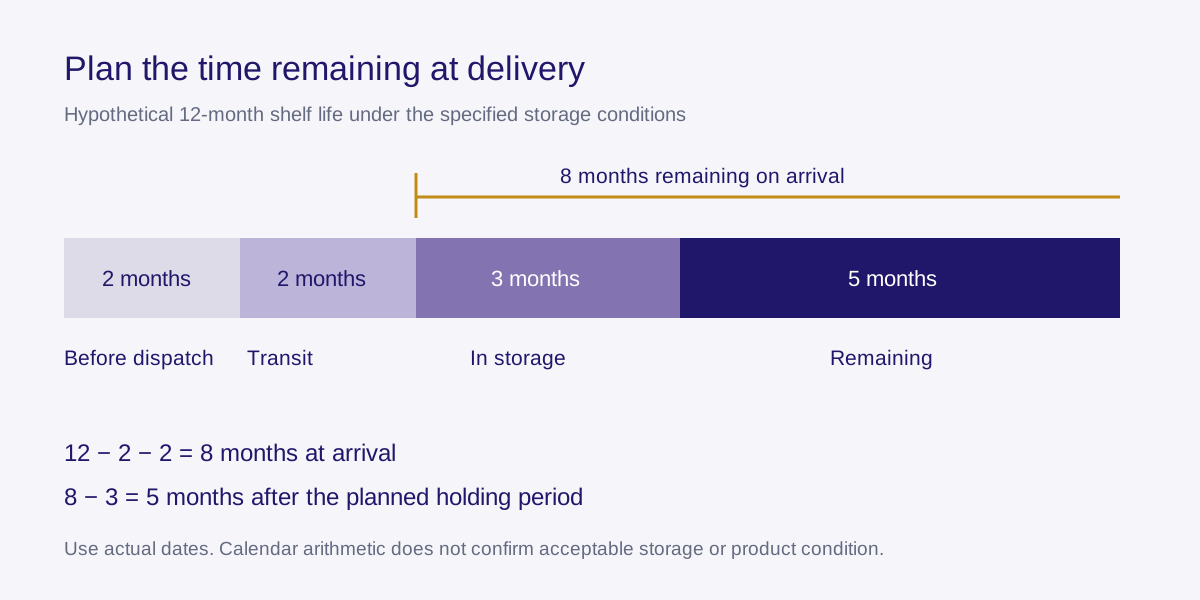
Consider a hypothetical product with a stated twelve-month shelf life under its specified conditions:
| Planning item | Illustrative period |
|---|---|
| Age when dispatched | 2 months |
| Transit and clearance | 2 months |
| Remaining shelf life at arrival | 8 months |
| Planned distributor holding time | 3 months |
| Remaining time after that holding period | 5 months |
The arithmetic is 12 − 2 − 2 = 8 months at arrival, followed by 8 − 3 = 5 months after the planned holding period. Use actual dates for an order rather than treating every month as the same number of days.
This is a calendar calculation only. It does not establish that the storage conditions were met, nor extend the labelled expiry date. A temperature excursion or damaged seal requires a separate assessment.
Use the result to challenge the buying plan. If the sales forecast requires longer than the remaining period, discuss a smaller first shipment, fresher production or a different delivery schedule rather than hoping stock will move faster.
4. Specify a minimum remaining life, not just “fresh stock”
“Fresh production” can mean different things to a factory, trader and distributor. Replace that phrase with a measurable requirement at a named point: dispatch, port arrival, delivery to warehouse, or another agreed milestone.
An RFQ might request confirmation of the manufacturing-date range and the minimum remaining shelf life at the buyer's warehouse. The acceptable value should come from the product's real storage period and the buyer's distribution plan, not a universal percentage copied from another category.
Also define how mixed batches will be handled. If several manufacturing dates appear in one shipment, the buyer needs visibility of quantities by batch. Otherwise, a headline average may hide stock with much less time remaining.
Ask how delays will be managed before the order is released. A change in sailing date should trigger a review of remaining life, not simply an updated shipping notification. Agree the commercial response with the supplier; do not assume that a delayed route automatically changes the product's expiry.
5. Do not confuse storage, application and service temperatures
Technical documents may list several temperature ranges. They answer different questions. A cured sealant's service-temperature range does not describe the conditions in which unopened cartridges can be stored. An acceptable application temperature does not automatically approve long-term warehousing at that temperature.
Read the headings around each number and record its purpose. For a product with a separate hardener, primer or activator, check the relevant components individually rather than using only the main product's range.
Sika's Sikaflex SL 1 information explicitly warns that elevated storage temperatures reduce shelf life. That supports checking heat exposure, but it does not provide a universal formula for every degree of temperature rise or every adhesive chemistry. Source: Sika Sikaflex SL 1.
If a supplier proposes a route outside stated conditions, ask for a written, product-specific assessment before accepting it. “It will be fine in summer” is not a traceable technical decision.
6. Map the entire handling route
Review each stage from factory release to the customer's store. Ask where the goods wait, who controls that location, and which conditions can realistically be monitored. A short ocean voyage can still be accompanied by substantial warehouse or port dwell.
For temperature-sensitive orders, discuss whether shipment monitoring is appropriate and how the information will be interpreted. A logger should support an agreed acceptance process; it is not useful merely as an accessory placed into the shipment.
Record the logger identity, placement rationale, start time, time zone and person responsible for retrieval. One device measures the conditions at its location, not automatically every package. Use a monitoring plan proportionate to the product and route.
Where a reported exposure falls outside the specification, preserve the full record and request the manufacturer's assessment. Do not invent a correction such as subtracting one month of shelf life for every hot day. Without supporting product data, that apparent precision is misleading.
7. Consider cold exposure as well as heat
A shipment intended for a warm destination can pass through a cold origin warehouse or an intermediate route. Water-based products should be checked for their specific protection-from-freezing requirements. Do not assume a product is unaffected because the container later returns to room temperature.
Sherwin-Williams' paint-storage guidance identifies both freezing and excessive summer heat as concerns when choosing a storage environment. Its consumer guidance is a useful reminder of temperature risk, not a shipping specification for all coatings. Source: Sherwin-Williams paint storage guidance.
Avoid applying refrigeration or reheating rules from an unrelated product. Different chemistries and packages can require different handling. Follow the exact technical and safety documentation, and ask the supplier how suspected temperature damage should be assessed.
For purchasing, the important question is not whether the route is described as “hot” or “cold.” It is whether the complete route can meet the conditions specified for the goods being shipped.
Technical support
Planning an export shipment?
Share the destination, expected transit time and storage conditions. Request product-specific shelf-life information before confirming quantities.
8. Treat packaging integrity as a release requirement
An intact outer carton does not automatically establish that every primary container is correctly sealed. Define the packaging checks that are relevant to the selected goods and agree how they will be sampled and recorded.
Potential checks include product identity, closure condition, visible leakage, container deformation, readable batch coding and consistency between labels and packing lists. For multi-component materials, verify that the correct components and quantities remain together.
These are suggested inspection questions, not a claim that one inspection standard covers every paint, cartridge, aerosol or adhesive. The package design and handling requirements should come from the actual product and approved logistics plan.
Do not open saleable stock indiscriminately to inspect it. Agree which units may be sampled, how opened samples will be identified, and how the remaining goods retain traceability. Inspection should create useful evidence without creating additional product-condition problems.
9. Keep quality and transport-safety documents distinct
A technical data sheet describes product characteristics and use instructions. A safety data sheet provides hazard and handling information. A batch certificate, where supplied, records specified batch-related results. A packing list identifies what is included in the shipment. These documents have different jobs.
Do not use an attractive product description as evidence that a shipment is non-hazardous. Equally, do not assume that every water-based product has the same transport status or that all solvent-containing products share identical requirements.
Ask a qualified freight provider to review the current SDS and the exact formulation, package and route. Any applicable transport classification, documentation and handling requirements must be checked for that shipment. This article does not assign a dangerous-goods class or give a regulatory exemption.
Keep the approved documents accessible to receiving and sales teams. A product can be purchased correctly and still be mishandled if the storage instructions remain only in the procurement manager's email inbox.
10. Create an incoming inspection and quarantine process
At receipt, compare the goods with the purchase order and packing list before mixing them into normal inventory. Record product codes, quantities, batch dates and visible package condition. Photograph discrepancies and retain the delivery reference.
Where monitoring was agreed, retrieve the records promptly. If there is suspected damage or an out-of-condition exposure, separate the affected stock and mark it as awaiting review. Prevent a questionable batch from being sold while the investigation is still open.
Ask the manufacturer which checks are appropriate. Appearance, viscosity, extrusion or cure observations may be relevant to particular products, but no single informal check proves all performance properties. A material that looks normal may still require further evaluation.
Document the disposition: released, returned, further tested or otherwise handled under an authorised decision. Keep that decision linked to the batch. A clear process protects the buyer from both unnecessary rejection and unsupported acceptance.
11. Use first-expiry-first-out inventory control
For dated products, first-expiry-first-out is more informative than assuming the first delivery should always be the first sold. Different products and batches may have different expiry dates, even when they arrive together.
Record a minimum set of fields in the stock system: product code, pack, batch, manufacture date where available, expiry date, receipt date, quantity and any hold status. Use actual package coding and confirmed supplier interpretation, not a guessed date format.
Place short-dated stock where the warehouse team can identify it, but do not sell it into a project whose installation schedule extends beyond the acceptable period. Ask customers about planned use when the remaining time is material to the purchase.
Review slow-moving colours, specialist grades and unusual pack sizes separately. A good total sales forecast can conceal a small quantity of stock that rarely moves. Order mix is therefore part of shelf-life management, not just a marketing decision.
12. Make complaints traceable and technically useful
If a customer reports poor extrusion, abnormal consistency, failure to cure or unexpected application behaviour, collect the evidence before deciding the cause. Request the product code, batch, dates, storage history, photographs and description of the application.
Distinguish unopened stock from opened material and identify any mixing, dilution or preparation steps. Ask whether the problem affects one container, one batch or multiple shipments. Preserve representative samples where appropriate and safe.
Do not automatically attribute a problem to hot transport, and do not automatically dismiss storage as irrelevant. Compare the available information with the agreed specification and obtain the supplier's technical review.
Where customer requirements include factory testing or shipment inspection, reference the actual agreed records. A claim such as “every batch is fully tested” is useful only when the tests and acceptance criteria are identified. Traceability makes investigation possible; a generic quality slogan does not.
Frequently asked questions
How long can unopened paint or adhesive be stored?
There is no single valid period for every product. Use the shelf life stated for the exact formulation, package and storage conditions. Confirm the date from which the period is measured and do not substitute a competitor's published value.
Can hot weather shorten adhesive shelf life?
Some manufacturers explicitly identify elevated storage temperatures as a shelf-life risk. The acceptable conditions and response to an excursion are product-specific. Do not use an unsupported universal temperature-to-ageing formula to release a shipment.
Is material acceptable if it is still before the expiry date?
The date is important, but it does not prove that the packaging remained intact or the storage conditions were met. Review condition and handling history as well as the label. Suspect stock should be assessed before use or resale.
Can expired material be used after a quick test?
A quick visual or application check does not independently extend shelf life. Request a documented manufacturer assessment and any required testing. Do not relabel or promise performance based only on an informal sample that appears satisfactory.
What remaining shelf life should an importer request?
Work backwards from distribution time, customer use dates and a reasonable planning buffer within the product's actual storage period. State the required remaining life at a named delivery point. There is no universal percentage suitable for every product and market.
Are larger orders always more economical?
Not necessarily. A lower unit price may be offset by warehousing, slow-moving stock and insufficient remaining shelf life. Compare the proposed order quantity with realistic sales by product, colour and pack size before committing to a container mix.
Conclusion
Shelf-life control is a purchasing, logistics and inventory task. Identify the exact product and package, calculate remaining life at delivery, confirm storage conditions, inspect the shipment and preserve batch traceability through resale.
The aim is not to obtain the longest date printed on a label. It is to receive material with a documented condition and enough remaining time for the intended distribution and application plan.